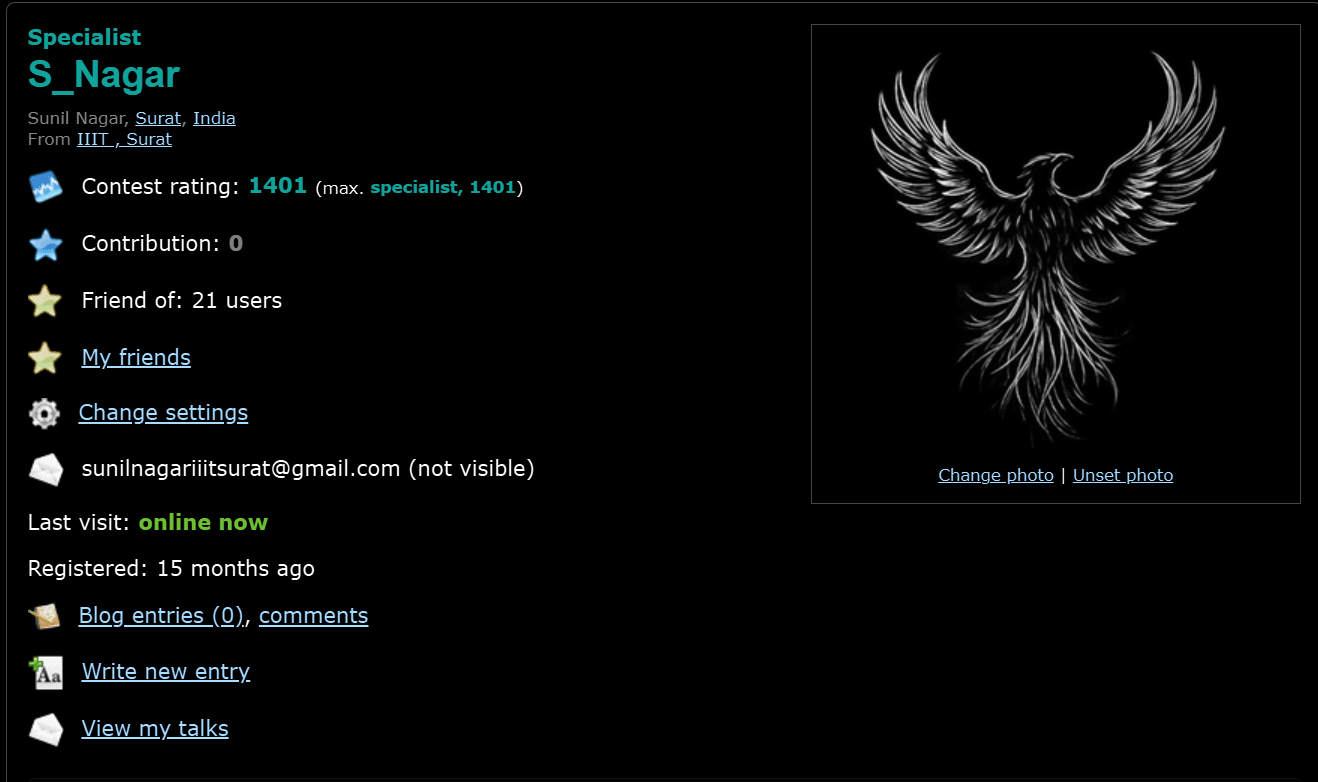
How I Reached Specialist on Codeforces
My journey from a beginner competitive programmer to achieving the Specialist rank on Codeforces through consistent practice, problem-solving, and learning from mistakes.
Introduction
Competitive programming has been one of the most rewarding parts of my computer science journey. When I first started solving problems, even simple implementation questions felt difficult. Reaching the Specialist rank on Codeforces was not something that happened overnight—it was the result of consistent practice, learning from failures, and gradually improving my problem-solving skills.
In this blog, I share the approach, challenges, and lessons that helped me achieve this milestone.
The Beginning
Like many beginners, I started with basic programming concepts and online problem-solving platforms. At that stage, my focus was simply on learning algorithms and improving logical thinking rather than chasing ratings.
My early contest experiences were far from ideal. I often struggled with:
Slow problem-solving speed
Implementation mistakes
Missing key observations
Unfamiliar problem patterns
Many contests ended with disappointing results. However, instead of getting discouraged, I treated every contest as an opportunity to learn something new.
Building Strong Fundamentals
One of the biggest factors behind my improvement was strengthening my fundamentals.
Data Structures
I focused on becoming comfortable with:
Arrays
Strings
Sets and Maps
Stacks
Queues
Algorithms and Techniques
I spent significant time mastering:
Sorting
Binary Search
Prefix Sums
Greedy Algorithms
Basic Graph Traversals
Rather than rushing toward advanced topics, I made sure I could confidently solve problems based on these core concepts. This strong foundation made it easier to learn more complex techniques later.
The Importance of Consistent Practice
A major lesson I learned was that consistency matters far more than intensity.
Instead of trying to solve dozens of problems in a single day, I focused on maintaining a sustainable routine:
Solving problems daily
Participating in Codeforces contests regularly
Upsolving unsolved contest problems
Reading editorials after making my own attempts
Maintaining notes on common techniques and mistakes
Even a few quality problems each day created steady progress over time.
Learning from Contest Mistakes
One habit that accelerated my growth was conducting a detailed post-contest analysis.
After every contest, I reviewed:
Wrong submissions
Time spent on each problem
Missed observations
Alternative solutions
New techniques used by other participants
Initially, I believed participating in more contests would automatically improve my rating. Over time, I realized that analyzing mistakes often provided more value than the contest itself.
This process helped me identify recurring weaknesses and systematically work on them.
The Turning Point
The biggest turning point came when I stopped focusing on rating changes.
Earlier, my mindset was:
"How can I gain rating?"
Eventually, I shifted my focus to:
"What skill is preventing me from solving the next problem?"
This small change had a huge impact.
Instead of worrying about temporary rating fluctuations, I concentrated on improving problem-solving ability. As my skills improved, better contest performances and rating gains naturally followed.
Reaching Specialist
Achieving the Specialist rank was not the result of one exceptional contest.
It was the cumulative outcome of:
Hundreds of solved problems
Countless hours of practice
Many unsuccessful contests
Continuous learning and improvement
For me, Specialist was more than just a rating milestone. It was proof that consistent effort and disciplined practice eventually produce results.
Key Lessons I Learned
Throughout this journey, several lessons stood out:
1. Consistency Beats Intensity
Small daily efforts are more effective than occasional bursts of motivation.
2. Upsolving Is Extremely Valuable
Many important concepts are learned after the contest ends.
3. Editorials Should Be Studied Deeply
Simply reading an editorial is not enough. Understanding the reasoning behind the solution is what matters.
4. Contest Analysis Accelerates Improvement
Reviewing mistakes helps prevent repeating them in future contests.
5. Ratings Follow Skill Development
Focusing on skill growth is more productive than obsessing over rating changes.
What's Next?
Reaching Specialist is only one step in my competitive programming journey.
My current goals include:
Improving problem-solving skills further
Performing better in Codeforces contests
Preparing seriously for ICPC
Learning advanced algorithms and data structures
Working toward higher Codeforces ratings
There is still a long way to go, and I look forward to the challenges ahead.
Conclusion
My journey to Specialist taught me that success in competitive programming comes from patience, discipline, and continuous learning.
Every solved problem, every failed submission, and every contest contributed to this achievement.
For anyone starting their competitive programming journey, my advice is simple: practice consistently, learn from your mistakes, and focus on improving your skills. Progress may seem slow at first, but with enough persistence, the results eventually follow.